If your server’s mail is suddenly rejected, one possible reason is that your IP is on a blocklist (DNSBL). Checking is simple, but interpreting the answer and getting delisted have their own steps. This guide covers it without paid tools.
1. How a DNSBL works
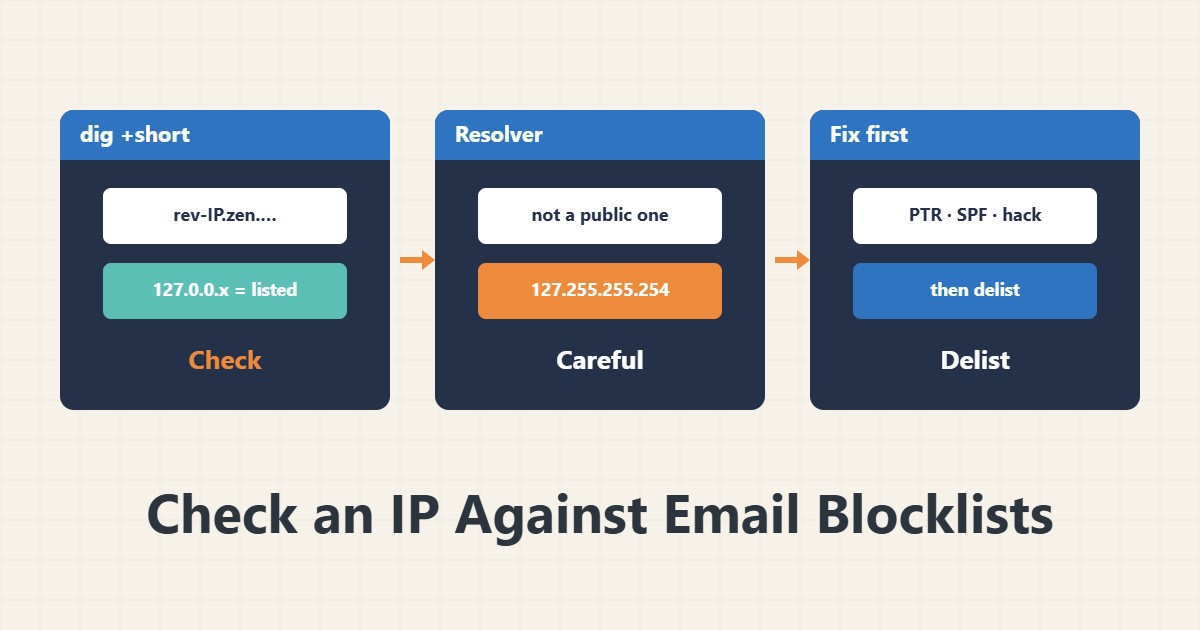
Blocklists use DNS: you write the four parts of the IP in reverse and append the list name. An answer of 127.0.0.x means you are listed and NXDOMAIN means you are not. The sample IP 203.0.113.5 is reserved for documentation.
2. Check with dig
ip=203.0.113.5
rev=$(echo "$ip" | awk -F. '{print $4"."$3"."$2"."$1}')
dig +short "$rev.zen.spamhaus.org"
Empty output means you are not listed. Test several lists, because each has its own criteria. We have covered the dig tool before.
3. A warning about resolvers
Some lists, such as Spamhaus, do not answer queries from large public resolvers or return an error code (for example 127.255.255.254). That does not mean “not listed”; you must query through your own resolver or follow that list’s rules. High volume requires registration.
4. Fix the cause before delisting
A delisting request without fixing the root cause leads to being listed again. Common causes: a compromised WordPress site or script sending spam, sending without authentication, a mismatched PTR record (PTR setup) and incomplete SPF/DKIM. Check the mail system with SMTP testing.
5. Request delisting
The list’s own official page explains the removal path. Beware of services that charge for “delisting” and promise a guarantee. If the IP is shared, the listing may be due to a neighbour and you must talk to the provider.
6. Illustrative example, not a measurement
Suppose mail was rejected with 550 mentioning a blocklist. dig returned 127.0.0.x. After finding an infected script and securing sending with authentication, a delisting request was filed and after a few days the answer went back to NXDOMAIN. This scenario is an invented illustration, not a measurement.
7. Common mistakes
- Requesting delisting without fixing the cause.
- Reading 127.255.255.254 as being listed.
- Paying services that claim to remove you from lists.
- Testing against only one blocklist.
8. Frequently asked questions
What does NXDOMAIN mean? The IP is not on that list.
How long does delisting take? Depends on the list and cause; from hours to days.
What about a shared IP? Talk to the provider or get a dedicated IP.
9. Quick checklist
- The IP was reversed and dig was run.
- Several lists were checked.
- The resolver answer was read correctly.
- The cause (compromise, authentication, PTR) was fixed.
- A delisting request was filed through the official path.
If you need help reviewing performance or maintaining a server, see the server management services.
More server and WordPress guides are collected in the article archive.
Official references
Spamhaus ZEN blocklist · RFC 5782: DNS blocklists · Spamhaus resource hub